Welcome to
Chris Brady’s
Blog

“The only way to be happy, is to give happy.”

  • What follows is the Foreword I wrote for Orrin Woodward’s latest book.  It’s a great read, and obviously one I would highly recommend.

    IMG_0877

    Congratulations on picking up this book. I guarantee you have never read anything like it.  What follows in these pages is jolting, thoroughly researched, and painstakingly reasoned out.  At first it may even strike you as a bit out-of-the-blue, especially when compared to the issues the national media and other gatekeepers of information flow seem intent on making our priority.  As you will discover, this is no accident. The very fact that we hardly hear anything at all about what you are about to read screams loudly for its validity. As the saying goes, “The greatest trick the Devil ever played was convincing the world he didn’t exist.” 

    Make no mistake; what you are about to learn is indeed very real, and it affects all of us in meaningful ways every day. This book will show you that. It will uncover and document systemic plunder and rampant unfairness. Like an engrossing Agatha Christie mystery, it will expose an insidious plot and explain the crime with several “smoking guns” of evidence, taking you deeper and deeper with one stunning reveal after another. By the end you will view money and the economy, and especially your own particular financial situation, in an entirely new and unexpected way. In short, you will be changed. You will have a new perspective and arrive irreversibly at a new place. To borrow from the 1999 hit movie The Matrix, as does this book, you will have taken the “red pill” and learned life-changing truth. The financial world will never so readily fool you again.

    As with all information, however, one must always ask, “Who says?” The credibility of the messenger must be proportional to the magnitude of the message. And that’s the other astonishing thing about this book; it very likely could not nor would not have been written by anyone else. Orrin Woodward writes as Marco Polo returning from a journey to a distant and unknown land, as having “been there” and experienced it all firsthand. Growing up in a blue-collar home in a tiny rural village in Michigan, Woodward was out of the house at age eighteen and paid his own way through college, often living on a few dollars a week. He had no family wealth, connections, prospects, sponsors, patrons, or even fans. But somehow in approximately a decade and a half, he had won national engineering awards, built several successful businesses, become a millionaire many times over, written New York Times best-selling books, been listed in Inc. Magazine’s Top 20 Leaders in the world, and even set a Guinness Book World Record. It was precisely this journey from obscurity to notoriety and fortune that taught him the main thesis of this book: the financial system is intentionally rigged against the unsuspecting masses of people who strive futilely within it. If Woodward had not struggled so mightily himself to rise up and climb the slippery slope from lower middle class to the 0.5% income earners and beyond, he would never have seen it. Further, he would not have had the freedom to invest the thousands of required hours of study and research to gain the insights and find the evidence for what is here presented. Finally, Woodward’s broad knowledge and experience as an engineer, entrepreneur, consultant, counselor, writer, speaker, world traveler, international business owner, investor, theologian, philanthropist, economist, and all-around modern polymath make him uniquely qualified and positioned to sound this clarion call.

    The message of this book is important, timely, and necessary. What happens as a result of its publication could be hugely important for mankind and the world’s economy, but even more so, for you. Read on and don’t miss a thing, and prepare to “see” many things for the first time, anew.


  • The following list was transcribed from a Live talk given by Chris Brady

    I believe these 12 habits are the secrets to a successful life! 

    Chris Brady’s Daily Dozen

    1. Word
      • Be in the Word of God and pray every day.
    2. Walk
      • Workout or do something physically active every day.
    3. Water
      • Drink more water every day.
    4. Watch
      • Stand guard against temptations and the forces that lead to destruction. Watch what you watch; watch what you eat; watch what you spend. 
    5. Work
      • Throw your heart over the bar. Do what you were meant to do and do it with passion.
    6. Wonder
      • Stop and think. Never lose your sense of wonder.
    7. Love
      • Express love to those who deserve it, and even to those who don’t.
    8. Read
      • Read to grow at least 30 minutes a day or more.
    9. Listen
      • Listen to learn. Listen to your children; listen to your spouse; listen to nature; listen MORE every day. 
    10. Associate
      • Interact intentionally in meaningful relationships with good people in positive ways.
    11. Rest
      • Rest is a strategy and a very important component to healthy living. Have an appropriate balance of hard work and rest.
    12. Thank
      • Learn to give thanks and be grateful every day.

    If you practice these 12 daily habits in your life, 20 years from now, you will look back at this list and be glad that you did.

    Chris Brady

    [Posted by Kristen Seidl, on behalf of Chris Brady]


  • The following excerpt was taking from the book, Financial Fitness, written by co-author, Chris Brady.

    There are some financial problems you need to beware of: the danger zones of personal finance. Specifically, there are ten things that are probably the most dangerous moments in someone’s financial life. Whenever you get near any of these ten things, stop, think about it, disengage your emotions, and engage your logic because all of these are thin ice.

    Money

    1. Taxes – Make sure you get a good tax adviser because the tax code can be pretty complicated. Never break the law. Never skate the edge. But make sure you understand the tax laws so you don’t waste a bunch of money that you’re not required to pay.
    2. Home Ownership – We have been taught that homes are great to own. Maybe that is true for some people in the right circumstances, but being a homeowner is one of the most expensive things you will ever do. Not only is the upkeep a significant expense, but property taxes and insurance are very costly. In societies with weak or struggling economies, increased property taxes will be one way that cities, municipalities, and other local governments attempt to stay afloat. And despite popular myths, homes do not always go up in value. This was the big idea that got popped during the last housing bubble. Many people have found themselves upside down on their homes, meaning they owe more than the home is now worth. This is a bad place to be. It is not our advice to own a home, or to avoid owning a home, but rather to be very wise. Do not make the mistake of seeing your home as a major investment, and think through the financial ramifications before you buy.
    3. Divorce – Don’t divorce him! Don’t divorce her! Work it out! If you don’t, it is going to cost a lot of money. Of course, you need to do what is right for you and your family. Our point is simply that this can be a very dangerous financial move, so think it through from all angles. It might be the most expensive thing you ever do.
    4. Credit Cards – Many people need to stay away from credit cards. We discussed this earlier in the book, several times in fact, but if you have not yet followed our advice, then (for crying out loud) put the plastic back in the wallet. Cut them up. Get rid of the things. Freeze them. Lock them up. Just stop using them. Credit cards are fine for people who have proven their ability to be disciplined with their finances. But for those with challenges in this regard, this warning is properly aimed.
    5. Lawsuits – They are very expensive, and they can distract from your work, business, family, and other important facets of life. If you are living the principles of financial fitness, you will have the best and only real preparation for lawsuits: savings and financial discipline. Avoid lawsuits whenever possible, and never look at them as a way to gain something financially.
    6. Uninsured Accidents and Sickness – Look, we know this is a tough world. But we have literally seen people cancel their health insurance because they “can’t afford it.” Yet they have tons of credit card debt, a flat screen TV, recreational vehicles, fancy cars, boats, etc. Get yourself some insurance. Sell some stuff. Walk around in a barrel in you have to! Get insured, even if it is just major medical insurance that kicks in if you have a big emergency. Protect yourself and your finances. Too much insurance is a waste and too little is a risk. Avoid both extremes. It is wise for people to look into getting the following kinds of insurance: home/rental, car, major medical, life, disability, long-term care, and identity theft protection. Also look into what insurance is needed for your kind of business. Protect your assets.
    7. Status Living – Having to keep up with the Joneses (or the Zhangs, as they increasingly say in China) can really kill your financial fitness. If you haven’t noticed, the Joneses are probably broke. Following their example is bad for your finances. Actually, to tell the truth, the Zhangs are spending only a little and saving a lot. Keeping up with the Zhangs, and not the Joneses, is a really good idea. To repeat what we already said: Stop buying things you don’t need with money you don’t have to impress people you don’t even like.
    8. College Education – We use the word “education” kind of lightly, depending on what college and where you go. College has become ridiculously expensive, partly because of all the scholarships given out, but mostly because of the ease with which kids can get government loans. This tends to drive the whole market price up. Be very careful that you get what you pay for. Take some time to think it through before you plunk down all that hard-earned money on a college just for reputation. Turn on your analytical brain, and treat it like an investment. Either make sure you (or your kids) get trained in something that will really bring the return you want, or focus more on getting a great education and less on getting a degree. To be clear, we think you should get a truly excellent education. This is one of the most important investments you will ever make. We just don’t believe this happens in college as often or as well as many people expect it to. If you do choose college, be sure you get the education you really want—or go and find it elsewhere. Note that the costs of college rise about 8% annually, while statistics show that the cost of a college education isn’t a very good investment anymore. A large percentage of people never work in the field of their degree, but they leave school with thousands of dollars in student loans. Ironically, as schools focus increasingly on narrow job training instead of broad education, people are getting less in the way of education and also using their expensive degrees less after graduation. For example, 85% of people who graduated from college in 2011 were unable to find a job and moved back in with their parents. Even more stayed away but still could not find good employment. It is increasingly common to find people with prestigious college degrees working in menial or fast-food jobs. Peter Thiel, the billionaire co-founder of PayPal, recently offered a number of $100,000 grants to students who were willing to drop out of college and start a business. Many top leaders are increasingly seeing college as a waste of time. As college becomes more expensive and less valuable, we expect to see more such alternatives that work for people better than college. Again, if you do go to college, focus on your education— not the conveyor belt requirements of the system.
    9. Addictions – Very often when we talk to people and they have some serious holes in their finances, we find out there is some type of addiction behind the scenes. Fight those off. Get professional help. Get treatment. As tragic as these things are personally and to the family, they are also just as bad financially. Clean up your life.
    10. Investments – The rule on investing is “buyer beware.” If those seeking your investment need your money, they do not qualify for it. If you don’t retain 100% control of your money, you are going to lose a whole lot of it; we promise. We have learned this through sad experience. The best investments are found on the YOU, Inc. Investment Hierarchy. About 95% of North Americans should not be in Kiyosaki’s “I” quadrant, which is investors only. Most should be in the “B” (business owner) quadrant. Those who try to become investors too soon are usually trying to invest like millionaires while earning like the middle class. This is the opposite of the real goal, as discussed earlier: to earn like a millionaire and live like the middle class. Also, amateur investors generally get slaughtered by the professionals.

    Be very, very careful as you make decisions about the danger zones: taxes, home ownership, divorce, credit cards, lawsuits, insurance, seeking status, college, addictions, and investments. Get good advice from your financial mentors, and study things in detail before taking action.

    As you become financially fit, do your best to avoid the financial danger zones, and be extremely careful as you make decisions when they do present themselves.

  • The following excerpt was taken from SPLASH! A Leader’s Guide to Effective Public Speaking. [Introduction written by Chris Brady]

    Beginning public speakers usually think there are three main types of speakers: good, bad, and somewhere in between. Advanced speakers—those who really know how to read every crowd, speak to each person’s heart and mind in a way that moves them deeply, and leave the listeners forever changed.

    For top leaders, public speaking is about SPLASH!

    In truth, splashes are amazing. They cause immediate waves, followed by a lot of ripples. And in the process, many people get wet or even muddy. If you’ve ever visited Sea World and watched the giant splashes from the whales arch far into the sky and then drench a stadium full of people, you know what a successful speech is all about.

    In fact, if you watch a Sea World crowd, even the people far up in the top bleachers, who don’t get a drop of water on them, react to each huge splash by jerking backward, covering their faces, and acting in other ways as if the wave were coming right at them.

    Every drop from a big splash causes a series of ripples. People go home and share what they learned and, even more important, what they felt. SPLASH speaking is an essential part of what we call Level 5 Leadership: developing leaders who develop leaders.

    Indeed, the memories created by effective SPLASH speaking endure for a lifetime.

    Just think of the best speech you’ve ever heard. Picture the event in your mind. Did you hear it in a stadium, at church, in the car, or somewhere else?

    What made it so great? Was it the ambiance? The lighting and cheering? The message? An electric energy in the room? The force of nature that seemed to emanate from the speaker? The notes you took and how they changed you later? A specific quote or phrase that seemed to switch on a light bulb in your mind? Or something else?

    Chris Brady

    Whatever your answer, one thing is certain. Great speeches, SPLASH speeches, leave you different than you were before you heard them. You feel something, and the feeling has a lasting impact on you and your life. The ripples of what you felt and learned during the speech continue in your life long after the big waves have come and gone.

    Beginning speakers often try to “break the ice” by using jokes, visual aids, gimmicks, or other techniques to pique the interest of the audience. Top leaders know that there is a better way, that in fact, gimmicks are really just gimmicks and that the same joke or visual aid will be mediocre when used by a struggling speaker but burn a lasting memory when employed by a great speaker.

    It’s not the techniques, it’s not just the preparation, and it’s not even the message that matters most. It’s the SPLASH that causes real change, that leaves listeners different, that ignites those in the crowd and sways their future.

    So what exactly is SPLASH? In addition to symbolizing how to become a speaker who touches every person in the audience and leaves a lasting memory, SPLASH is an acronym for the following guidelines of truly effective speakers:

    Say something that matters.
    Prepare the speaker, not just the speech.
    Leave it all backstage.
    Audience is everything.
    Simplicity is power.
    Happen!

    Note that SPLASH speakers aren’t born; they’re made. It takes effort, practice, and repetition to become a great speaker. Sitting in an audience listening to a world-class speech, it is easy to get the false idea that the speaker is just plain gifted. Certainly, there are people with various gifts that help their public speaking, but nobody ever became an excellent speaker without hard work.

    For example, attend a professional football game or a nationally recognized orchestra performance, and you’ll be amazed at how some of the athletes and musicians make their work seem so simple. But what they do is actually far from easy. If you knew the long years of practice, workouts, lessons, failures, struggles, sweat, and effort that brought them to this moment, you’d be amazed.

    Any true success is built on a genuine foundation of intense and consistent work.

    The same is true of great speakers. That said, understanding SPLASH will help you fast-forward past years, even decades, of trial and error.

    Mentoring is incredibly powerful for this very reason: An experienced mentor can help you jump ahead by applying his wealth of experience and skipping many hurdles along the way. 

    If you begin applying the principles of SPLASH speaking right now, today, your public speaking will start improving by leaps rather than baby steps.

    There is an old saying that “practice makes perfect.” This is actually only partially true. The reality is that the right kind of practice makes perfect. In other words, practicing skills incorrectly tends to lessen them and reduce your effectiveness.

    Those who apply the principles of SPLASH speaking can start practicing the right way, and this will drastically accelerate their learning curve. Moreover, if you have ever stressed about public speaking or felt nervous before a speech, SPLASH speaking will help you conquer your fear and forget about yourself.

    Indeed, this is a hallmark of great speakers: They tend to forget about themselves and immerse their delivery in the needs of their audience. SPLASH speaking will teach you how to do this simply, immediately, and effectively.

    There is much to learn, but becoming a better public speaker will help you in countless ways. So get ready to get wet—because a SPLASH is coming!

    To purchase the book SPLASH! A Leader’s Guide to Effective Public Speaking, click here.

    [Posted by Kristen Seidl, on behalf of Chris Brady]

  • The following excerpt was taken from SPLASH! A Leader's Guide to Effective Public Speaking. [Foreword written by Chris Brady]

    I sat in my little metal folding chair absolutely petrified. My hands were sweaty, my posture slumped, and I couldn’t hear a word the presenter was saying. All my faculties were consumed with the fear of my impending doom.

    What was so downright terrifying?

    I was about to give my first official public presentation! I was eighteen years old and an engineering co-op student at General Motors. More for our benefit than anything else, at the end of each semester, we co-op students were required to give a review of our work assignments and accomplishments that term.

    They were despicable affairs, to be sure, with a dim little old-fashioned bulb-type overhead projector and amateur flimsies comprised of lots of really unimportant information. One by one, each victim would get up and grind through a horrid three minutes.

    Soon it would be my turn.

    My memory blanks at this point. Perhaps it’s some sort of protection mechanism, the kind of thing that eliminates our past tragedies from memory or at least preserves our self-image by refusing to remind us of times when we made complete fools of ourselves! At any rate, I can’t recall one detail about that presentation except for how scared I was beforehand.

    This condition didn’t go away anytime soon, either. Year after year, we went through the same drill, and I was just as scared each time.

    Fast forward to today, where I basically make my living speaking in front of audiences around the world. I give approximately fifty public talks a year to  audiences of all sizes and have been doing so (and often more) for almost twenty years. Now, I don’t even break a sweat. I am not only not scared by speaking in public; I actually relish each moment!

    What happened?

    If you’re like me at all, you probably can relate to the fear and trepidation I describe above. For some reason, most of us feel that way when we’re asked (or forced) to get up in front of a group and deliver any kind of message.

    Chris BradyFor me, the fear gradually dried up as I found myself in business for myself and confronted by the necessity of delivering information to other people through the spoken word. The proverbial “time on the water” did a lot to calm my nerves and make me feel comfortable speaking in front of a crowd. 

    But overcoming the fear of public speaking is only one part of the equation. The second, much bigger consideration is to overcome the tendency that afflicts almost all public speakers at some point in their development—namely, that of being boring and ineffective. Sadly, it seems as if the vast majority of public presentations are somewhere between merely adequate and downright sleep-inducing. There are reasons for this.

    In the book SPLASH, you will become acquainted with specific steps you can take to put together and deliver engaging, entertaining, informative, and inspiring public talks. You will be encouraged to practice your ability to speak in public (by doing it often—the only sure way to finally get rid of those nerves) and equipped with the principles and specifics of how to make your talks truly effective.

    I am convinced that public speaking is something anyone can master. As with many other things in life, it doesn’t really matter where you start but only that you do actually start! And once you’ve thus begun, the goal is to improve as quickly as you can. Put the thoughts and concepts to work for you, and take your public speaking to a whole new level.

    Finally, imagine a speaker getting ready for a major speech to a large audience in a full arena.

    He feels no nerves, no worries. Instead, he is excited to share his message. As the time for his speech arrives, he gets ready to go onstage.

    He listens to the current speaker, taking notes and thinking about how to apply what she’s saying to his own situation. When they call for the break, he smiles and stands up. A friend walks past and asks, “Are you ready?”

    “Ready for what?” he asks curiously.

    “For your speech?”

    “Oh.” He is genuinely surprised.

    “What are you going to speak about?” the friend asks while the technician attaches the microphone to the speaker’s belt and tie.

    “I’ve got a new concept I want to share,” he says. Then he asks about his friend’s work and family. He hasn’t seen him for a while.

    When the master of ceremonies reopens the convention, he pulls out his note cards and glances at his outline. He’s been through it so many times in his mind that he doesn’t get past the first line. He immediately starts thinking of better ways to share it.

    He stops himself, puts the note cards into his briefcase, and then leaves it on the table. He walks to the side of the stage, ready to head up the stairs to speak. He can see part of the audience from his vantage point, and he can already feel their energy, which only adds to his own excitement to share this vital message with them. “I love this!” he says to himself. “I can’t imagine being anywhere I’d like better.”

    “This is so much fun. I’m ready to speak.…”

    And you will be too. This is the goal for great speakers, along with delivering a transformational speech that really makes a difference to everyone in the audience. This is what we call SPLASH speaking, and is something we can all work toward as speakers.

    More to come…

    To purchase the book SPLASH! A Leader's Guide to Effective Public Speaking, click here.

    [Posted by Kristen Seidl, on behalf of Chris Brady]

  • You’ve got it. We’ve got it. Seems that nearly everyone’s got it—stuff, I mean. Stuff is the stuff that we have sitting around our houses, garages, and especially basements. Some people go so far as to have stuff stored in a separate facility across town, or at an in-law’s house strewn across their front yard, or at any number of Auxiliary Stuff Storage Locations.

    Rich people have stuff, and usually lots of it. Interestingly, though, even poor people seem to have lots of stuff, although stuff of a lesser quality or luster. Young people have stuff, too, but old people generally have even more stuff (out-of-style stuff, to be sure). Before you’re even born, people are holding “showers” and giving you stuff. Each year you’ll celebrate your age, and they will give you more stuff. And after you’re gone, they’ll bicker over the stuff you’ve left behind.

    In our own home, we have stuff stored behind other stuff. Some stuff sits on top of other stuff, while other stuff just hides behind stuff. Some stuff is stuffed behind stuff, while still other stuff is out on display. But the older we get, the more we live, the more stuff we seem to have.

    It’s not all bad, really. Some stuff is pretty important. Take refrigerators, for instance. That’s the kind of stuff that we all need—what’s inside them, that is—and toilets and furniture and forks and cars and stamps and beds and a pretty huge, boring, and definitely too-long list of stuff that we actually need around.

    ClutterBut what drives me crazy is the rest of the stuff: the stuff that we just accumulate, like knick-knacks…tall ones and short ones, big ones and small, ugly ones and stylish things your wife got at the mall, dusty stuff and old stuff and broken stuff and kids’ stuff, pet stuff and loaned stuff and present stuff and forgotten stuff.

    Whenever I hear about someone who likes to shop, I picture a big pile of stuff. Isn’t that really what shopping is, driving around trading money for more stuff? Drive it home and put it in amongst all your other stuff. And eventually, the total inventory of stuff gets quite overwhelming. This is because of the sticky nature of most stuff.

    The most dangerous combination in a marriage is a shopper married to a pack rat. One makes a hobby out of buying stuff while the other refuses to part with stuff. The home of such a couple gets stuffed with stuff.

    What can one do with all this stuff? Cram it and stuff it and store it and hide it. Or one can sell it. This is interesting because who in the world would want someone’s stuff when everybody already has more than enough stuff of their own? I know. It is a perplexing puzzle, but people with stuff actually buy the stuff of other people with stuff at events called garage sales (although garages are not for sale), yard sales, or auctions. People line up to buy your stuff. They are even willing to pay twenty-six cents for stuff that cost you $450.

    Or, you can give away some stuff. Pack it and wrap it and box it and donate it. The taxman will even give you a credit for giving away the stuff. This is so you will have more money to buy more stuff, and the government can tax the purchases and get money to buy stuff of its own, such as $600 toilet seats and $345 screw drivers. Given this, it is easy to see why even the government has garage sales (called federal liquidations) once in while: to sell us the stuff they bought with the money they took from us when we bought our stuff. It’s a stuff cycle of perpetual renown.

    And that brings me to recycling. This is a concept where other people express concern over what you do with your stuff. (They don’t care what you do with it while you possess it, only when you discard it.) They say some stuff should be ground up or melted or something and made into other stuff. It’s another stuff cycle.

    It seems, now that I have taken such an in-depth, scientific look into the nature of stuff, that stuff is like a bad case of athlete’s foot—very difficult to get rid of. Take a trip someplace, and there your wife is packing up all of your stuff. There are your kids, fighting over stuff. There’s the robber, stealing someone’s stuff. There’s the envious, wanting another’s stuff. There’s the communist, confiscating stuff.

    Try as you may through life, you will be forced to deal with stuff. Most of it looks pretty good when it’s new, but just becomes stuff in a very short while. Maybe that’s why they say the best stuff in life is stuff that’s not even stuff.

    Sincerely, 

    Chris Brady

    Chris Brady

  • The following excerpt was taken from EDGE, co-authored by Chris Brady and Orrin Woodward. 

    We heard a great saying one time that went like this: “Don’t be like everyone else—even if you’re the only one.” This is especially true when it comes to talking about other people behind their backs.

    In the course of life, it will be common to find yourself in situations in which people are gathered and discussing someone who is not present. This is fine, as long as what is being said is positive and nice. Many times, however, this won’t be the case. For some reason, people just love to drift toward the negative and point out everything they think is wrong about another person. This is a terrible, terrible habit and must be avoided by anyone who wants to live a worthy life and have great relationships. Chris Brady
    Talking about others behind their back, gossiping about what they did or what they said, is like stealing; it’s stealing a portion of their good reputation. Perhaps people do this because they think that by tearing another person down, they somehow are making themselves look better. But remember: when you throw mud, you will always lose ground.

    Instead, be the kind of person that refuses to speak ill of other people when they are not present. Even more so, become the one who defends those who are not present. Throw in a little, “Let’s not talk about Sally when she’s not here,” if things get out of control. You may think people will be slightly offended by you stopping their gossip train in such a way, but actually, deep down inside, they will be making a mental note that you are trustworthy and will likely defend them if anyone ever gossips about them.

    Posted by Kristen Seidl, on behalf of Chris Brady.

  • The following excerpt was taken from EDGE, co-authored by Chris Brady and Orrin Woodward

    We once heard the story told of a young man who worked at a sporting goods store. He was in his second year of college and struggling to pay for tuition and room and board. One day, a wealthy older man walked into the store and purchased a large amount of fishing gear for a fly-in fishing trip. The young man helped carry the mountain of purchases out to the parking lot and immediately noticed the expensive luxury car the older man drove. Impressed, the younger man asked a very penetrating question.

    “Sir, if you don’t mind, could I ask you a question?”

    “Certainly,” replied the elder gentleman.

    To which the young man asked, “How do I get to be where you are financially some day?”

    Hesitating briefly to ensure the young man was actually sincere, the older gentleman thought for a moment and formulated his answer carefully.

    “First, define what you really want in life. Second, find someone who has accomplished that exact lifestyle and learn from that person how he or she did it. Third, go do exactly what he or she did.”

    With that, the older man got into his luxury car and drove away.

    We first heard this story told by a man who claimed to have been that young man who worked at that sporting goods store and to have used the very advice he received that day to succeed at a very high level. We are not sure, but the story may even be allegorical. That makes no difference. The truth remains that the principle taught by this nice little anecdote is profound.

    Think about it. Most of the world has this equation exactly the other way around. Have you ever been asked a question something like this?

    “What do you want to DO when you grow up?” or “What are you going to DO after high school?” Of course, we all have. It’s an indication that the person asking the question is using the following equation:

    1. Determine what you think you would like to DO.
    2. Then LEARN how to do it.
    3. And finally, allow it to DEFINE your results in life.

    But what the wealthy fisherman taught was exactly the opposite:

    1. DEFINE the life you would like to have.
    2. Find someone who has accomplished that life and LEARN from that person how to do it.
    3. And then DO it.

    Chris Brady

    You see? While most of the world falls into the rut of DO, LEARN, DEFINE, the super successful switch it around backward to DEFINE, LEARN, DO!

    What does this mean for you? It means that at ANY AGE, you can run the equation the way the super successful do. You can DEFINE the exact life you’d like to live. Such a definition should be very specific, very exciting, and cover many categories, such as financial rewards and lifestyle, contributions to society
    and charity, involvement in community groups and church, family relationships and love, even down to things like where you’d like to live and how you’d like to be remembered. The list is really endless and as individual as each person is unique. However, very few people will take the time to truly define where they want to go in life. But for those who do, it throws the equation of how to live entirely upside down!

    Try it and see if it isn’t liberating to do as the late Stephen Covey taught, to “Begin with the end in mind.” DEFINE how you’d like to live right down to the very detail. Be in tune to any calling you feel on your life. Pay attention to any natural affinities or talents you possess. Package these all together, to the best of your ability, into a vision for where you’d like to go with your life. Only then, and we mean ONLY then, should you move on to the next step, which is also profound.

    The next step is to find someone who has succeeded in achieving a life much like the one you now envision for yourself. This may be difficult, but don’t give up. Usually, successful people are the type who are constantly on the lookout for people to help, AND they almost always appreciate it when they come across someone who is eager to become like them. So look around and see if you can find mentors in key areas of your life who have achieved the types of results in those categories you’d like to accomplish yourself. Learning from such people is absolutely priceless. This is because they will think and act very differently from “everyone else.” And usually in life, you are forced to spend a lot more time with the “everyone else's” than you are those who have achieved the stellar results of which you are dreaming. Ultimately, you will think and behave a lot like the people you hang around the most. So take the advice of the wealthy fisherman and choose people to be around that are where you want to be in life.

    Finally, it is time for the DO step. Take massive action toward your goals and don’t grow weary in the pursuit. Anything worthwhile takes significant time and effort. Expect that. Stay persistent. Keep your eye on the accomplishments you hold dear in your heart. Run for the approval of those you’ve chosen to emulate, NOT of those who don’t understand what you are trying to achieve. Remember, most people will think you’ve got it backwards. But actually, they’ve got it backwards.

    So DEFINE your life, LEARN from those who’ve achieved that kind of life already, and DO what they did with all your heart. It will be worth it. We promise! And who knows? You might just become a wealthy fisherman to some future young person, too!

    Posted by Kristen Seidl, on behalf of Chris Brady.

  • This post was transcribed from a Live talk given by Chris Brady.

    I was speaking at an event one time and someone asked me this question, “If you had to attribute one thing to your success, what would it be?” To which I responded, “The grace of God first, but then I really believe it is consistent, productive, daily, habits.”

    I came across some interesting research by an author named Tom Crowley who researched the habits of the rich. Here are just a few statistics from his study:

    1. 86% of the rich work more than 50 hours per week.
    2. 27% of the rich have failed at least once in business.
    3. 80% were focused on pursuing only one major goal.
    4. 88% read 30 or more minutes per day, strictly for learning.
    5. 63% listen to audio books on a daily basis to learn.
    6. 54% are eternal optimists.
    7. 67% watch less than an hour of TV per day.
    8. 81% maintain a daily to-do list and prioritize that list on a regular basis.
    9. 94% saved 20% or more of their income.
    10. 89% slept 7 or more hours each night.
    11. 76% exercise aerobically at least 30 min per day, 4 times a week.
    12. 75% avoid fast food.

    Where this study got really interesting was when Crowley started comparing the habits of the rich to the habits of the poor.

    1. Only 12% of the poor were focused on pursuing at least one major goal.
    2. 0% of the poor had ever run for a goal for more than one year.
    3. Less than 2% of the poor read to learn.
    4. Less than 5% listen to audio books to learn.
    5. 77% of the poor watch more than one hour of TV per day.
    6. 87% of the poor spend more than one hour on the internet, recreationally.
    7. 97% of the poor eat more than 3,000 calories per day.
    8. 69% of the poor eat fast food frequently.

    Habits are just as powerful on the negative side as they are on the positive. And you can't just break a bad habit. You have to replace a bad habit with a good habit. Based on this research, it’s obvious that when you look at a person’s results in life and then you look at their habits, there’s a direct correlation.  

    CBFurther, Crowley’s study noted that rich people intentionally build relationships with other successful people and they spend time thinking about and developing those relationships; they make an effort to stay connected and they actively provide value to those people. The rich are also more open minded than the poor because the poor generally have limiting beliefs and closed off ideologies.

    There’s one more ideology by Crowley that is worth mentioning. And the best way I can anchor it in your minds is with a story.

    About 120-130 years ago, a geologist from Pennsylvania was in pursuit of a rare earth metal in the Amazon rain-forest. Back then, there was not a lot of technology, travel, or medicine and it was very dangerous to go deep into the rain-forest. However, he recruited four people to go with him who had specific skills that would help round out his team so he could make his way into this remote place deep in the Brazilian jungle.

    This crew was there for several months and they didn’t really understand what the geologist was trying to accomplish. To them, someone who takes this kind of dangerous, risky journey should be in pursuit of gold; not some earth metal. They didn’t understand what it was that he was looking for. But, the four men had been paid in advance so they decided to stay the course. Eventually, the good geologist contracted malaria. Because there wasn’t proper medicine in those days, and no access to a doctor, he knew he was doomed.

    So, the geologist started packaging up a big wooden crate. He told his crew that the contents inside was a secret and they had to promise on his life that they would bury him in the jungle, put a cross on his grave, and take the crate back to the University of Pennsylvania. The geologist told them, “I promise you, if you manage to get this crate safely back to the university, it will prove to be more valuable than gold for you.”

    Intrigued by this and sad that they were going to lose their new boss and friend, when the geologist died a few days later, the four men buried him as he requested and then started to wheel the big wooden crate back through the jungle and out of the Amazon. Eventually they got on a ship and made it back to the University of Pennsylvania.

    It was a grueling journey. Many times the four of them started to squabble. Each of them had different ideas about which direction to take and which local guides to believe. In fact, they got lost several times and started blaming each other. They ran out of food a couple of times and had to beg at some villages. There were several times when each of them thought about abandoning the task. But, there was just enough curiosity about what was so valuable in the crate that they stayed together through it all.

    Eventually, the four returned back to the port in Philadelphia. When they couldn’t stand waiting any longer, they got out a crowbar, broke the seal, pried open the lid, and opened the crate. At the very top, there was nothing but wood chips. So they started digging through the wood chips and reached nothing but sand. Then they started digging through the sand and reached nothing but gravel. So they start scooping out the gravel and they reach some sticks of wood. Still curious, they take the wood out and see two or three boulders. Then, at the very bottom of the crate, they saw  that there was nothing but a mixture of all of the elements…nothing valuable at all!

    “Better than gold?” they exclaimed. “What was he talking about?" So they walked away defeated and started questioning the geologist's motives. “Why did he do this to us? Was it suppose to be some kind of mystery or puzzle?”

    One of the men, who was a sea captain, sat down and said, “You know what, a lot of times when I’m at sea and the storms get high, I have to tell my sailors something to keep them unified and working together. I’ll sometimes have to assign them work that has nothing to do with anything. But I have to keep them busy and focused on something so we can all make it out alive. I believe that’s what the good geologist did to us. He gave us a unifying goal! He gave us a reason to stick together and not quit, even though we hated each other’s guts. And by golly, it worked! The crate didn’t have to go to the University of Pennsylvania, he just wanted that crate to get us home, and it did!”

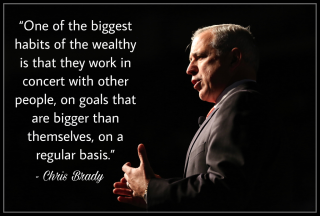
    What’s so powerful about this story is that in Crowley’s research, he mentions that one of the biggest habits of the rich is that they work in concert with other people, on goals that are bigger than themselves, on a regular basis.

    When you can combine efforts with other people, toward a goal that’s bigger than any one person, for reasons that are deeper than any of your own selfish desires and gratifications, and you work towards that goal consistently as a habit, not only is that what it takes to accomplish great things, but it actually gives you the unifying force to be successful.

    (Posted by Kristen Seidl, on behalf of Chris Brady)

  • The following excerpt was taking from Chris Brady's critically acclaimed book, Leadership Lessons from the Age of Fighting Sail.

    One trait common to all leaders is initiative. Leaders don’t have to be told to do something. They don’t need managers above them. They don’t wait for all the lights to turn green before departing on a trip. Leaders don’t waste time waiting and wondering if they should act. They take responsibility and take action. There is an old line that there are three types of people in the world: those who make things happen, those who watch things happen, and those who wonder what happened. Leaders are the ones in the first group making things happen.

    A component in initiative is the courage to act. Another is decisiveness. Leaders display a willingness toward action, seeing what needs to be done and doing it without delay. Initiative is not to be confused with recklessness. Instead, it is a mixture of a spirit of enterprise, courage, and competent decisiveness.

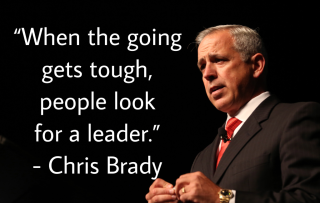
    Chris BradyWhat separates a leader from the rest is not only his ability to see what needs to be done but his unhesitating execution of it, even while others watch or deliberate. Leaders feel just as much trepidation as others, but they are able to muster the courage to press on anyway. This is why when the going gets tough, people look for a leader. They want someone with the courage to confront challenges and hit obstacles head on, thereby inspiring them to do the same. A leader absolutely must be courageous. As John C. Maxwell wrote, “A leader is one who knows the way, goes the way, and shows the way.” This cannot be done without courage.

    There is a spirit of enterprise distinctive of all true leaders, who see what needs to be done and do it without hand-holding or waiting for orders. Action is a keystone of leadership.

    The very concept of initiative stands upon the platform of accepting personal responsibility. Leaders function while called upon to make decisions in often confusing situations and possibly dangerous environments, without adequate time and/or information, making decisions to the best of their ability and then striving to make those decisions right. In short, leaders must be able to decide and then take full responsibility for their decisions.

    The initiative of a leader also births creativity and ingenuity as the objective remains frozen and the means are molded toward its purpose.

    Further, great leaders must have the grander picture in focus, being sure to serve the vision while serving their own interests and keeping the two aligned. This happens automatically when a leader acts according to the convictions of his or her character.

    (Posted by Kristen Seidl, on behalf of Chris Brady)